
Institute for Quantum Computing (IQC)
Areas of research: Information Quantique
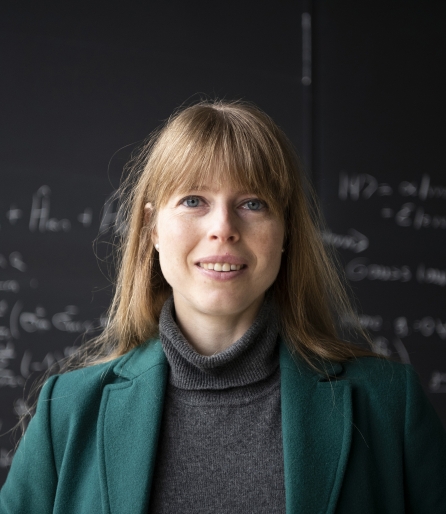
Prof. Christine Muschik holds a University Research Chair at the University of Waterloo. She holds a faculty position at the Institute for Quantum Computing and an associate faculty position at the Perimeter Institute for Theoretical Physics.
Christine Muschik received a number of awards for her work on quantum computers, including an Ontario Early Researcher Award, a CIFAR Azrieli Global Scholar Fellowship for “Research Leaders of Tomorrow”, and a Sloan Fellowship for outstanding early career researchers.
Her work on using quantum systems to perform hard calculations is internationally recognized and has been featured by Scientific American and Forbes. In 2016, her results on programming quantum computers to solve problems in particle physics has been named as one of the “Top 10 breakthroughs in Physics” of this year.
Today she pushes the frontier of scientific computing by developing a new generation of highly efficient quantum computing methods that are based on so-called qudits, i.e. computational units for quantum computers that go beyond binary encodings.
- University Research Chair, University of Waterloo, 2022-2029
- Associate professor, Institute for Quantum Computing and University of Waterloo, 2022-present
- Associate faculty member, Perimeter Institute, 2019-present
- Assistant professor, Institute for Quantum Computing and University of Waterloo, 2017-2022
- University assistant, Institute of Theoretical Physics, University of Innsbruck, 2016-2017
- Postdoctoral Position, Institute for Quantum Optics and Quantum Information in Innsbruck, 2014-2016
- Postdoctoral position, ICFO - The Institute of Photonic Sciences in Castelldefels (Barcelona), 2011-2014
- Feodor Lynen Research Fellowship, Alexander von Humboldt Foundation, 2011-2013
- MSc student Ryan Ferguson received Dean of Science award for innovative research, University of Waterloo, 2021
- President's Research Excellence Award, University of Waterloo, 2021
- Early Research Award, Government of Ontario, 2021
- President's Research Excellence Award, University of Waterloo, 2020
- Fellowship, Alfred P. Sloan Foundation, 2019
- New Frontiers in Research Fund, Government of Canada, 2018
- Discovery Grant, Natural Sciences and Engineering Research Council of Canada (NSERC), 2018-2013
- Atas, Y. Y., Haase, J. F., Zhang, J., Wei, V., Pfaendler, S. M. -L., Lewis, R., & Muschik, C. A. (2022). Simulating one-dimensional quantum chromodynamics on a quantum computer: Real-time evolutions of tetra- and pentaquarks. doi:10.48550/arxiv.2207.03473
- Kan, A., Funcke, L., Kühn, S., Dellantonio, L., Zhang, J., Haase, J. F., . . . Jansen, K. (2022). 3+1D $\theta$-Term on the Lattice from the Hamiltonian Perspective. In Proceedings of The 38th International Symposium on Lattice Field Theory — PoS(LATTICE2021) (pp. 112). Sissa Medialab Srl. doi:10.22323/1.396.0112
- Simulating one-dimensional quantum chromodynamics on a quantum computer: Real-time evolutions of tetra- and pentaquarks, Qiskit Quantum Information Science Seminar Series, IBM, 2023/07/01, Video URL
- Simulating one-dimensional quantum chromodynamics on a quantum computer: Real-time evolutions of tetra- and pentaquarks, Quantum Simulators of Fundamental Physics, 2023/06/05, PIRSA:23060002
- Fresh approaches for scientific computing, Singapore MinDef Visit, Institute for Quantum Computing (IQC), 2023/06/01
- Status and prospect of quantum simulating quantum fields: digital approaches, Toward Quantum Advantge in High Energy Physics, Munich Institute for Astro-, Particle, and Bio Physics (MIAPbP), 2023/04/01
- Next Challenges in Quantum Simulation, APS March Meeting 2023, APS, 2023/03/01
- Simulating Particle Physics with Quantum Computers, Synthetic Intelligence Forum, Synthetic Intelligence Forum, 2022/12/01, Video URL
- Fresh approaches for scientific computing, TQT Scientific Advisory Council Meeting, Transformative Quantum Technologies (TQT), 2022/10/01