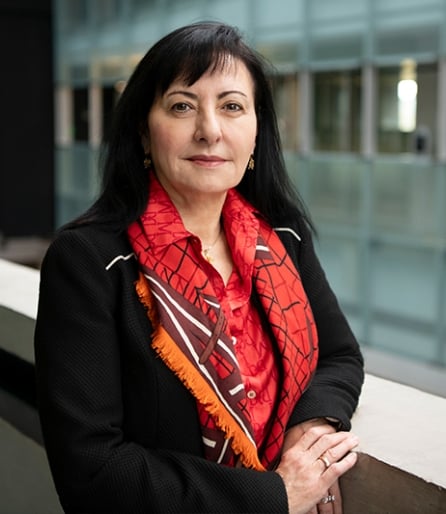
Executive Director

Perimeter Institute for Theoretical Physics

Research Faculty
Office of Executive Leadership

Areas of research: Particle Physics

Overview

Marcela Carena is the Executive Director of Perimeter Institute for Theoretical Physics. Carena is an award-winning distinguished scientist, who has been jointly appointed as a theoretical particle physicist at Fermi National Accelerator Laboratory (Fermilab) (1996 - 2024)  and a physics professor at the University of Chicago (2008 – present), where she is a member of both the Enrico Fermi Institute and the Kavli Institute for Cosmological Physics. She was formerly the Director of the Theory Division at Fermilab. Her research explores the possible connections between the Higgs boson, dark matter, and the origin of matter in the universe. She has been a leader in exploring radical new concepts such as supersymmetry and warped extra dimensions, particularly in showing how these ideas can be tested in experiments. She has worked closely with experimental physicists at the CERN Large Hadron Collider, at Fermilab and the University of Chicago, creating and implementing strategies for discovery. Recently, she has been exploring ideas at the boundary between particle physics and quantum information, to tackle problems of quantum theory and the early universe. In 2022, Carena was honoured as a US Office of Science Distinguished Scientist Fellow for leadership and influential contributions to particle physics and promoting Latin American participation in US-hosted experiments. In 2010, Carena won the Research Award from the Alexander von Humboldt Foundation, and she was a Simons Distinguished Scholar at the Kavli Institute in Santa Barbara in 2013. Earlier in her career she was a John Stuart Bell Fellow at CERN and was awarded a Marie Skłodowska-Curie Fellowship from the European Commission to conduct her research at Deutsches Elektronen-Synchrotron (DESY). Carena has been the chair of the Division of Particles and Fields as well as of the Forum on International Physics of the American Physical Society. She has represented the United States at the Particle Physics Preparatory Groups for the 2020 European Particle Physics Strategy Update, as well as at the first community exercise for the Latin American Strategy Forum for Research Infrastructure in High Energy, Cosmology and Astroparticle Physics. She continues to be actively involved in efforts in Latin America and other countries to strengthen scientific collaborations at a global scale and open new opportunities for scientists from diverse backgrounds. She has been a member of several international scientific advisory panels around the world, including the Natural Sciences and Engineering Research Council (NSERC) of Canada; the Serrapilheira Institute and the ICTP South American Institute for Fundamental Research in Brazil; and the Mainz Institute for Theoretical Physics and the DESY Physics Research Council in Germany. Carena has recently been a member of the US National Academies of Science, Engineering and Medicine’s committee setting a vision for the field of elementary particle physics for the coming decades. She is a Fellow of the American Association for the Advancement of Science (AAAS) and a member of the Academia Nacional de Ciencias Exactas, Fisicas y Naturales of Argentina.

Positions Held
  • Director of Theory Division, Fermilab, 2015-2025
  • Professor (on leave), University of Chicago, 2008-present
Recent Publications
  • Carena, M., Li, Y. -Y., Ou, T., & Singh, H. (2026). Real-time simulation of asymmetry generation in fermion-bubble collisions. Physical Review D, 113(1), 014502. doi:10.1103/nphy-2y8q
  • Carena, M., Ireland, A., Ou, T., & Wang, I. R. (2025). The discriminant power of bubble wall velocities: gravitational waves and electroweak baryogenesis. Journal of High Energy Physics, 2025(9), 175. doi:10.1007/jhep09(2025)175
  • Carena, M., Coloretti, G., Liu, W., Littmann, M., Low, I., & Wagner, C. E. M. (2025). Entanglement maximization and mirror symmetry in two-Higgs-doublet models. Journal of High Energy Physics, 2025(8), 16. doi:10.1007/jhep08(2025)016
  • Arganda, E., Carena, M., Rios, M. D. L., Perez, A. D., Rocha, D., Seoane, R. M. S., & Wagner, C. E. M. (2025). Machine-Learning Analysis of Radiative Decays to Dark Matter at the LHC. doi:10.48550/arxiv.2410.13799
  • Arganda, E., Carena, M., de los Rios, M., Perez, A. D., Rocha, D., Sandá Seoane, R. M., & Wagner, C. E. M. (2025). Machine-Learning Analysis of Radiative Decays to Dark Matter at the LHC. Journal of High Energy Physics, 2025(7), 14. doi:10.1007/jhep07(2025)014
  • Carena, M., Coloretti, G., Liu, W., Littmann, M., Low, I., & Wagner, C. E. M. (2025). Entanglement Maximization and Mirror Symmetry in Two-Higgs-Doublet Models. doi:10.48550/arxiv.2505.00873
  • Bahl, H., Carena, M., Ireland, A., & Wagner, C. E. M. (2024). Improved thermal resummation for multi-field potentials. Journal of High Energy Physics, 2024(9), 153. doi:10.1007/jhep09(2024)153
  • Carena, M., Lamm, H., Li, Y. -Y., & Liu, W. (2024). Quantum error thresholds for gauge-redundant digitizations of lattice field theories. Physical Review D, 110(5), 054516. doi:10.1103/physrevd.110.054516
  • Bahl, H., Carena, M., Ireland, A., & Wagner, C. E. M. (2024). Improved Thermal Resummation for Multi-Field Potentials. doi:10.48550/arxiv.2404.12439
  • Navas, S., Amsler, C., Gutsche, T., Hanhart, C., Hernández-Rey, J. J., Lourenço, C., . . . Zheng, W. (2024). Review of Particle Physics*. Physical Review D, 110(3), 030001. doi:10.1103/physrevd.110.030001
  • Carena, M., Low, I., Wagner, C. E. M., & Xiao, M. -L. (2024). Entanglement suppression, enhanced symmetry, and a standard-model-like Higgs boson. Physical Review D, 109(5), l051901. doi:10.1103/physrevd.109.l051901
  • Carena, M., Lamm, H., Li, Y. -Y., & Liu, W. (2024). Quantum error thresholds for gauge-redundant digitizations of lattice field theories. doi:10.48550/arxiv.2402.16780
  • Baum, S., Carena, M., Ou, T., Rocha, D., Shah, N. R., & Wagner, C. E. M. (2023). Lighting up the LHC with Dark Matter. Journal of High Energy Physics, 2023(11), 37. doi:10.1007/jhep11(2023)037
  • Baum, S., Carena, M., Ou, T., Rocha, D., Shah, N. R., & Wagner, C. E. M. (2023). Lighting up the LHC with Dark Matter. doi:10.48550/arxiv.2303.01523
  • Carena, M. (2023). Paving the Way for Electroweak Baryogenesis. In Paving the Way for Electroweak Baryogenesis. Office of Scientific and Technical Information (OSTI). doi:10.2172/2008056
  • Carena, M., Low, I., Wagner, C. E. M., & Xiao, M. -L. (2023). Entanglement Suppression, Enhanced Symmetry and a Standard-Model-like Higgs Boson. doi:10.48550/arxiv.2307.08112
  • Bahl, H., Carena, M., Coyle, N. M., Ireland, A., & Wagner, C. E. M. (2023). New Tools for Dissecting the General 2HDM. doi:10.48550/arxiv.2210.00024
  • Bauer, C. W., Davoudi, Z., Balantekin, A. B., Bhattacharya, T., Carena, M., de Jong, W. A., . . . Zorzetti, S. (2023). Quantum Simulation for High-Energy Physics. PRX Quantum, 4(2), 027001. doi:10.1103/prxquantum.4.027001
  • Bahl, H., Carena, M., Coyle, N. M., Ireland, A., & Wagner, C. E. M. (2023). New tools for dissecting the general 2HDM. Journal of High Energy Physics, 2023(3), 165. doi:10.1007/jhep03(2023)165
  • Carena, M., Li, Y. -Y., Ou, T., & Wang, Y. (2023). Anatomy of the electroweak phase transition for dark sector induced baryogenesis. Journal of High Energy Physics, 2023(2), 139. doi:10.1007/jhep02(2023)139
  • Slavich, P., Heinemeyer, S., Bagnaschi, E., Bahl, H., Goodsell, M., Haber, H. E., . . . Staub, F. (2023). Higgs-mass predictions in the MSSM and beyond. doi:10.48550/arxiv.2012.15629
  • Carena, M., Theoretical Physics Department, F. N. A. L., Kozaczuk, J., Liu, Z., Ou, T., Ramsey-Musolf, M. J., . . . Department of Physics and Astronomy, U. O. N. (2023). Probing the Electroweak Phase Transition with Exotic Higgs Decays. Letters in High Energy Physics, 2023. doi:10.31526/lhep.2023.432
Seminars
  • Opening Remarks, Charting the Future Symposium, 2025/08/25, PIRSA:25080016
  • Opening Remarks, QIQG 2025, 2025/06/23, PIRSA:25060001
  • Opening Remarks, Lee's Fest: Quantum Gravity and the Nature of Time, 2025/06/02, PIRSA:25060029
  • Panel Discussion, Theory + AI Symposium, 2025/04/07, PIRSA:25040079
  • Baryogenesis of the Early Universe, Colloquium, 2025/03/13, PIRSA:25030170